NavigationAGV and AMR: practical differences
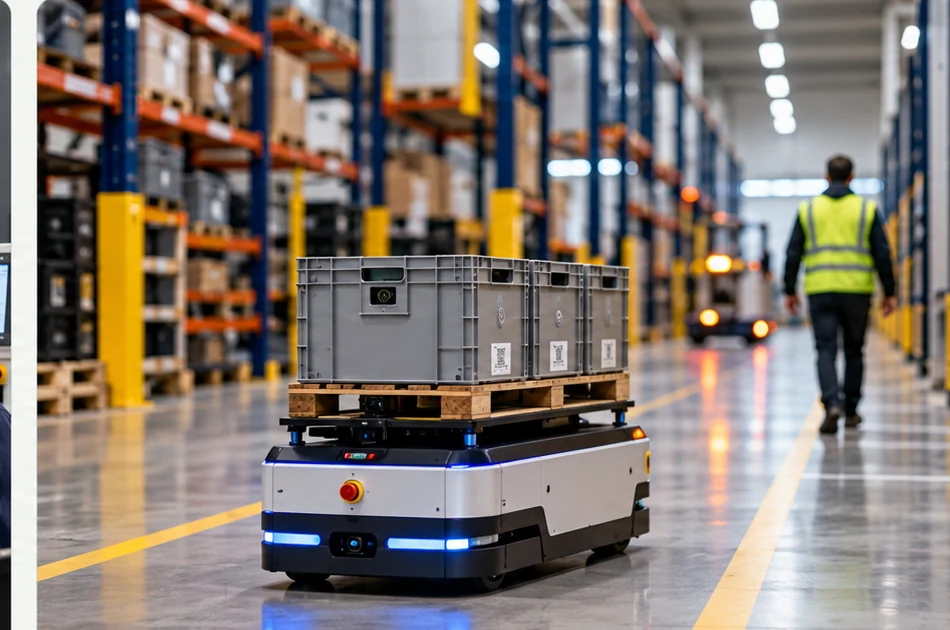
AGV with fixed guidance and AMR with dynamic navigation are families of material-handling solutions. Actual capabilities vary by system.
Essential checks
Measure flows, passageways, obstacles, mixed traffic, charging and integration. An AMR may stop if no safe detour exists.
Introductory guidance: verify the standards, manuals and specifications applicable to the project.
IFR terminology and standardisation ↗EU-OSHA: human–robot collaboration ↗Assess your project ↗HandlingRobotic arms: industrial and collaborative
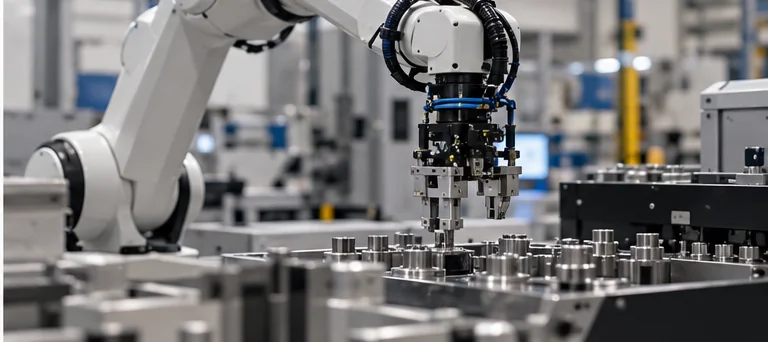
A robotic arm can perform pick and place, machine tending, assembly, screwdriving and palletising. Human–robot collaboration is an application mode, not a property that automatically makes a robot safe.
Essential checks
Check payload including tooling, reach, trajectories, accuracy, repeatability, cycle time, guarding and risk assessment.
Introductory guidance: verify the standards, manuals and specifications applicable to the project.
IFR terminology and standardisation ↗EU-OSHA: human–robot collaboration ↗Assess your project ↗ToolsGrippers and gripping systems
Mechanical grippers, suction cups and other end effectors must be selected according to workpiece geometry, surface, mass, fragility and variability.
Essential checks
Test gripping on real parts; check acceleration, loss of power, sensors and maintenance.
Introductory guidance: verify the standards, manuals and specifications applicable to the project.
IFR terminology and standardisation ↗EU-OSHA: human–robot collaboration ↗Assess your project ↗Integrated systemsMobile manipulators: AMR plus arm
A mobile manipulator combines movement and handling, but requires coordination of localisation, stability, tooling and mission control.
Essential checks
Distinguish stationary handling from handling while moving; verify stability, positioning accuracy and safety of the complete system.
Introductory guidance: verify the standards, manuals and specifications applicable to the project.
IFR terminology and standardisation ↗EU-OSHA: human–robot collaboration ↗Assess your project ↗ConformitySafety and integration
Risk must be assessed for the machine and its actual application, considering people, tools, speeds, crushing points, stops and operating modes.
Essential checks
For industrial robots, consider the ISO 10218:2025 and other applicable references. Verify documentation and conformity; do not assume that marking on the robot alone covers the entire cell.
Introductory guidance: verify the standards, manuals and specifications applicable to the project.
IFR terminology and standardisation ↗EU-OSHA: human–robot collaboration ↗Assess your project ↗Regulations and safety: full guide ↗Business caseROI and realistic payback
Time theoretically released does not necessarily reduce costs. Realisable benefits must be justified by operating data and a realistic plan.
Essential checks
Calculate the full investment, maintenance, tooling, training, downtime and support costs. Simple payback requires a positive net benefit and does not include discounting.
Introductory guidance: verify the standards, manuals and specifications applicable to the project.
IFR terminology and standardisation ↗EU-OSHA: human–robot collaboration ↗Assess your project ↗ These guides are original educational summaries and do not replace regulations, product manuals or professional engineering advice. The economic guide describes a general methodology, not experimental findings.