Transport and intralogisticsAMR · Autonomous mobile robots
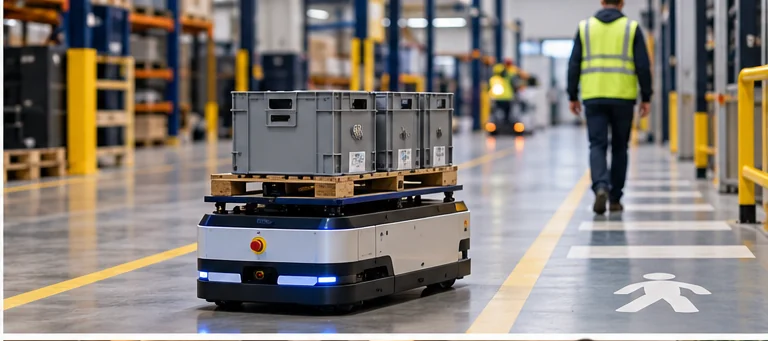
They plan movement missions and may adapt routes to the map and obstacles, according to system capabilities.
To be assessed
Route geometry, mixed traffic, payload, flooring, elevators, network and fleet management.
Important
An AMR does not guarantee passage around every obstacle: it stops if no safe trajectory is available.
Compare and select ↗Transport along structured routesAGV · Automated guided vehicles
They move loads along defined routes or guidance commands, with architectures varying by installation.
To be assessed
Routes, interference, guidance infrastructure, transfer points and safety.
Important
An AGV may have advanced functions: do not reduce the comparison to “AGV always stops, AMR always goes around”.
Compare and select ↗Handling and assemblyCollaborative robots
Industrial robots suitable for use in appropriately designed and validated collaborative applications.
To be assessed
Tool, force, speed, working area, repeatability, crushing risk and operator interaction.
Important
The “cobot” label alone does not make a workstation safe: the complete application matters.
Typical applications: machine tending CNC, pick and place, assembly, screwdriving and palletising. Collaborative safety concerns the complete application.
Compare and select ↗Automated productionIndustrial robots
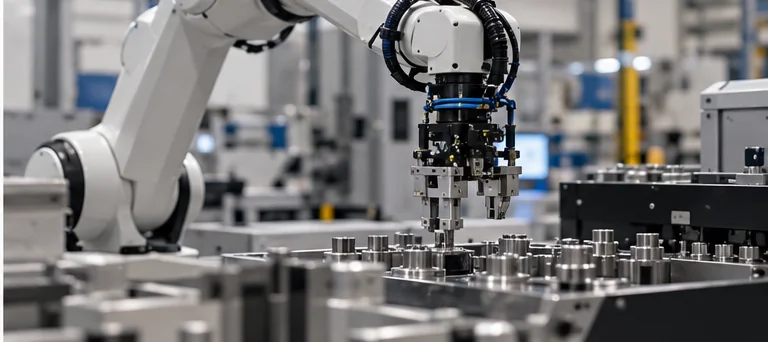
Programmable manipulators for assembly, welding, handling and manufacturing processes.
To be assessed
Payload, reach, accuracy, cycle, layout, guarding and line integration.
Important
Robot performance is not the same as the performance of the entire production cell.
Architectures: articulated, SCARA and Cartesian robots. Compare payload, reach, repeatability, cycle and layout.
Compare and select ↗Facility managementProfessional cleaning robots
Autonomous or semi-autonomous platforms for floor washing, vacuuming and maintenance.
To be assessed
Surface type, coverage, obstacles, runtime, consumables and maintenance planning.
Important
Performance depends on geometry, traffic and site conditions.
Compare and select ↗Food service and hospitalityService robots
Robots for internal deliveries, dish transport, reception and services in public-facing facilities.
To be assessed
Passage dimensions, manual loading and unloading, people, ramps, lifts, privacy and maintenance.
Important
Autonomous transport does not imply autonomous object handling.
Compare and select ↗Monitoring and diagnosticsInspection robots
Mobile platforms equipped with sensors for capturing images, measurements and data.
To be assessed
Environment, accessibility, sensors, calibration, traceability and data quality.
Important
A thermal or visual image alone does not constitute a validated diagnosis.
Compare and select ↗Complex terrain and environmentsQuadruped robots
Legged mobile platforms for reconnaissance and data capture in suitable scenarios.
To be assessed
Stability, steps, slopes, runtime, payload, safety, controls and maintenance.
Important
They are not necessarily more cost-effective than wheels, tracks or fixed systems.
Compare and select ↗ No technologies match your search.